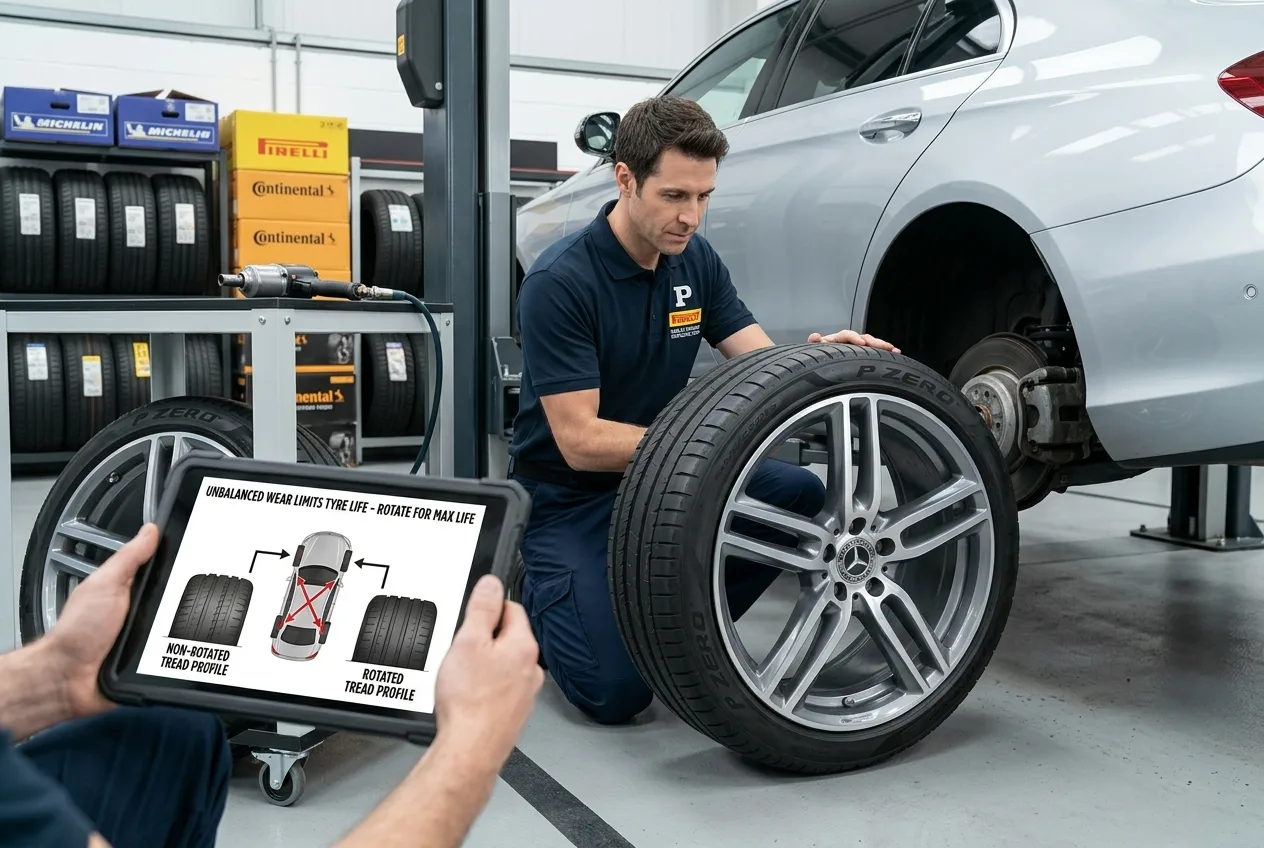
What Is Tyre Rotation?
Tyre rotation is the practice of moving tyres from one position on the vehicle to another — typically front to rear and sometimes side to side — on a scheduled basis. The goal is to equalise wear across all four tyres so that they reach the end of their useful life at roughly the same time.
The Wear Reality
Front tyres on most cars wear 2–3× faster than rear tyres because they handle steering, braking, and — on FWD cars — acceleration. Without rotation, you’ll replace front tyres twice for every rear set.
Why Tyres Wear Unevenly
Every position on a car subjects a tyre to different forces. Front tyres handle steering, a greater share of braking force, and engine torque on front-wheel-drive vehicles. Rear tyres are primarily responsible for propulsion on rear-wheel-drive cars. This means different positions wear at different rates.
On a front-wheel-drive car, front tyres wear 2–3 times faster than rear tyres
On a rear-wheel-drive car, rear tyres wear faster due to propulsion forces
The driven axle always carries more wear than the non-driven axle
Cornering forces cause the outer edges of tyres on the steered axle to wear faster
How Tyre Rotation Helps
Equalises Wear Across All Four Tyres
By periodically moving tyres to different positions, each tyre experiences the full range of forces rather than concentrating wear in one pattern. This leads to all four tyres wearing at a more similar rate, extending the overall set life.
Extends Total Tyre Life by Up to 20%
Regular rotation can extend the useful life of a set of tyres by up to 20%, meaning you get more kilometres from the same investment. For premium tyres that represent a significant cost, this saving is meaningful.
Maintains Consistent Handling and Safety
When tyres on the same axle have significantly different wear levels, the vehicle’s handling becomes asymmetric. The car may pull to one side, particularly under braking, which is both uncomfortable and potentially dangerous. Regular rotation keeps all four tyres at similar depths, maintaining balanced handling.
Saves Money on Replacements
If all four tyres wear evenly, you replace all four at once. Without rotation, you typically replace two at a time but more frequently, with the added cost of multiple installation visits. Over the lifetime of your car, regular rotation results in fewer total tyre purchases.
The Simple Rule
Rotate every 8,000–10,000 km — or simply do it at every service visit. It takes 15 minutes and can add 20,000+ km to your tyre life.
How Often Should You Rotate Tyres?
The standard recommendation is to rotate tyres every 8,000 to 10,000 km. A practical approach is to have tyres rotated at every other oil change if you service your car every 5,000 km, or at every oil change if you service at 10,000 km intervals.
Refer to your vehicle owner’s manual for the manufacturer’s specific recommendation, as some vehicles may have different requirements based on drivetrain type.
Rotation Patterns for Different Drivetrains
The correct rotation pattern depends on your vehicle’s drivetrain and whether your tyres are directional or non-directional.
FWD: Move front tyres straight to the rear. Move rear tyres to the front, crossing sides. This is the standard “forward cross” pattern.
RWD: Move rear tyres straight to the front. Move front tyres to the rear, crossing sides. This is the “rearward cross” pattern.
AWD: Use the “X pattern” — each tyre crosses to the opposite corner. This ensures maximum equalisation of wear across all positions.
Staggered fitments (wider rears): Cannot be rotated front-to-rear. Some performance cars require side-to-side rotation if non-directional, or may not be rotatable at all.
Directional Tyre Warning
Directional tyres can only be rotated front-to-rear on the same side — never crossed. Check your tyre sidewall for a rotation arrow before rotating. Getting this wrong can damage the tyre or create handling problems.
Rotation vs Alignment — What Is the Difference?
| Factor | Tyre Rotation | Wheel Alignment |
|---|---|---|
| What it does | Moves tyres between positions | Adjusts wheel angles |
| Frequency | Every 8,000–10,000 km | Every 10,000–15,000 km |
| Prevents | Uneven wear between positions | Uneven wear within a tyre |
| Also improves | Tyre lifespan, cost savings | Handling, fuel efficiency |
Both services are complementary — rotation and alignment together provide the most complete tyre care. Many dealers offer both in a single service visit.
Frequently Asked Questions
Can I rotate directional tyres?
Yes, but only front-to-rear on the same side. Directional tyres have a V-shaped tread pattern designed to rotate in one direction. They cannot be crossed to the opposite side of the vehicle without dismounting and remounting the tyre on the rim.
My car has a space-saver spare. Can I include it in the rotation?
No. A space-saver spare is only meant for temporary use and is not designed for rotation into regular service. Only include a full-size spare in the rotation if it matches the other four tyres in brand, model, and size.
Does rotation help if one tyre is already significantly more worn?
If the wear difference is large (more than 2–3 mm of tread depth), rotation at that point may not be beneficial and could create handling imbalances. It is better to replace the worn tyre and then begin a regular rotation schedule with the new set.
Final Thoughts
Tyre rotation is one of the simplest and most cost-effective ways to extend the life of your tyres. At Radial Factory, we recommend scheduling rotation with every second service visit — our technicians will check tread depth and advise on the correct pattern for your specific vehicle.