Why Timely Replacement Is Important
Worn tyres significantly increase your risk of accidents. Tread depth directly affects your ability to brake quickly, maintain grip during cornering, and resist aquaplaning in wet conditions. Driving on degraded tyres is not just illegal below certain tread depths — it is genuinely dangerous for you, your passengers, and other road users.
Many drivers replace tyres only after a puncture or blowout. A proactive approach — monitoring tyre condition regularly — prevents these incidents and can save significant repair costs in the long run.
The Hard Truth
In India, most tyre failures happen because drivers wait too long to replace. If your tread depth is below 2mm or your tyres are older than 5 years — replace them now, not next month.
How Long Do Tyres Last?
As a general rule, tyres last approximately 40,000 to 50,000 km under normal driving conditions. In terms of time, most manufacturers recommend replacing tyres after 5 to 6 years regardless of apparent tread depth, and tyres should never remain in service beyond 10 years from the date of manufacture.
Several factors affect how quickly tyres wear:
Driving style — aggressive acceleration and hard braking accelerate wear significantly
Road conditions — rough Indian roads, potholes, and debris increase wear
Tyre pressure — under-inflated tyres wear faster on the edges; over-inflated tyres wear faster in the centre
Wheel alignment — misaligned wheels cause uneven and rapid tyre wear
Load — consistently overloading your vehicle accelerates wear
Climate — high temperatures in Indian summers increase rubber degradation
7 Top Signs Your Tyres Need Replacement
Tread Depth Below the Safe Limit
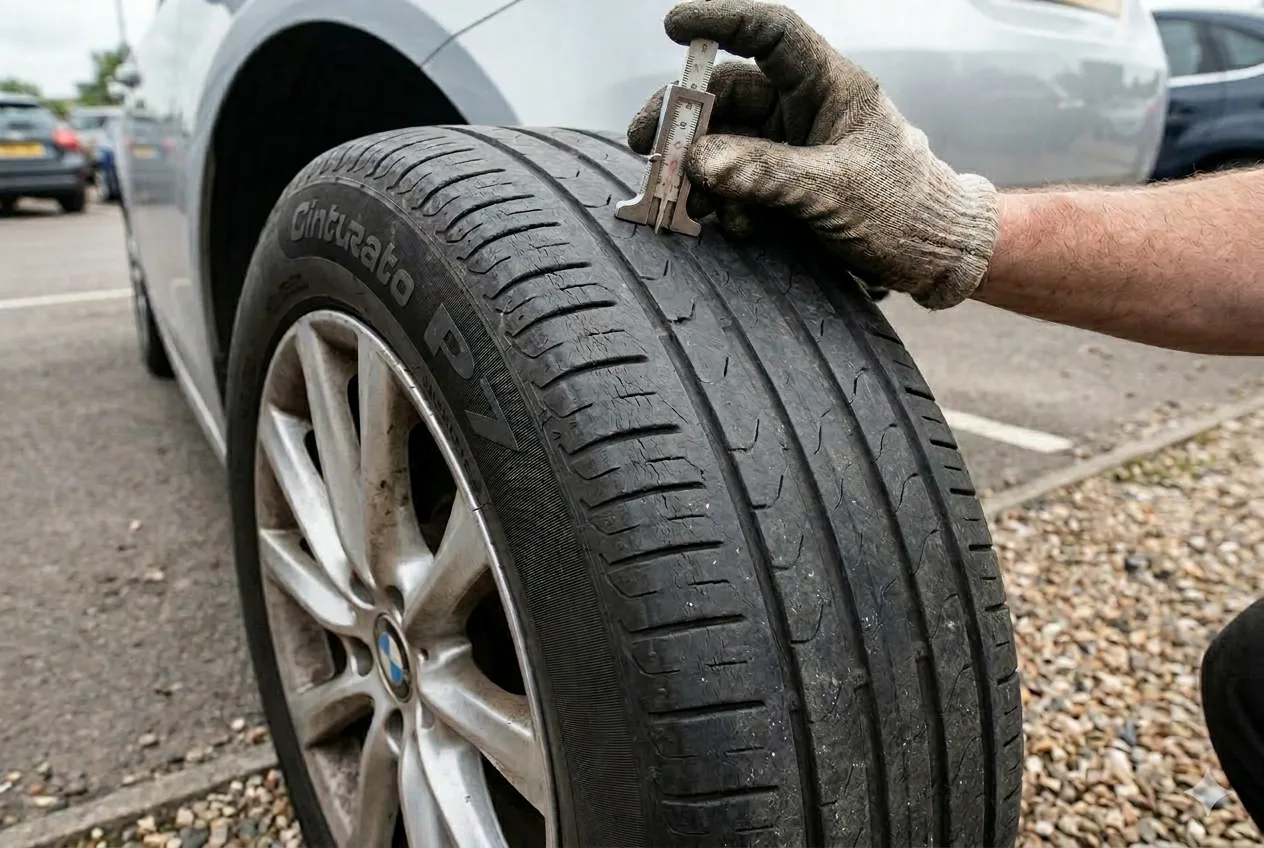
The legal minimum tread depth in India is 1.6 mm, but most tyre experts recommend replacing at 3 mm. Below 3 mm, wet braking distances increase dramatically. Look for the tread wear indicators — small rubber bridges moulded into the grooves of most modern tyres. When the tread surface is level with these indicators, it is time to replace. You can also use a 1 rupee coin: if the outer rim is visible when inserted into the groove, your tread is dangerously low.
Cracks or Cuts in the Sidewall
Inspect the sidewalls regularly for cracks, cuts, or grooves. Sidewall cracking is often caused by UV exposure, ozone, and ageing of the rubber compound. Even small cracks are a sign that the rubber is deteriorating and the tyre may be at risk of sudden failure. Sidewall damage cannot be repaired — the tyre must be replaced.
Persistent Air Loss
If one tyre repeatedly loses pressure even after patching or valve replacement, it may have a structural issue. A slow leak that cannot be located may indicate a porous or cracked inner liner. Continuously driving on an underinflated tyre causes heat build-up and accelerates internal damage.
Bulges or Blisters
A bulge on the sidewall or tread indicates that the internal cord structure has been damaged — usually from hitting a pothole or kerb at speed. The outer rubber is holding pressure that the damaged inner structure can no longer contain. A tyre with a bulge can blow out without warning and must be replaced immediately.
Vibration While Driving
Some vibration can be caused by wheel imbalance or alignment issues, but if these have been checked and ruled out, internal tyre damage may be the cause. Delamination (where layers of the tyre separate internally) can cause vibration that worsens at higher speeds.
Uneven Wear Patterns
Different wear patterns indicate specific problems. Centre wear suggests over-inflation; edge wear suggests under-inflation; one-sided wear suggests alignment issues; patchy or cupped wear suggests balancing problems or worn suspension components. While the underlying cause should be addressed, uneven wear can also mean the tyre needs replacement if the affected area is below the safe tread depth.
Age Over 5 Years
Even if a tyre appears to have adequate tread, the rubber compound degrades over time through oxidation and heat cycling. Pirelli and most manufacturers recommend replacing tyres after 5 years of service. Check the DOT code on the sidewall — the last four digits indicate the week and year of manufacture (e.g., “1822” = 18th week of 2022).
Stop Driving Immediately
If you see a bulge or blister on any tyre, stop driving immediately. Internal structural damage cannot be repaired — the tyre must be replaced. Continuing to drive risks a sudden blowout at speed.
Pro Tip
Replace new tyres on the rear axle first. Rear tyre failure is harder to control than front tyre failure — especially at speed.
When to Replace All Four Tyres
Replacing tyres in pairs (both front or both rear) is generally recommended to maintain balanced handling. For AWD and 4WD vehicles, replacing all four at the same time is often essential — mismatched tread depths can stress the differential and drivetrain components.
If your remaining two tyres are near the end of their life anyway, replacing all four together is more economical and ensures consistent performance and wear going forward.
Best Time to Replace Tyres in India
The period before the monsoon season (typically May–June) is an ideal time to check and replace tyres. Wet road grip depends heavily on tread depth, and entering the monsoon on worn tyres significantly increases the risk of aquaplaning and accidents.
Why Choose Premium Tyres for Replacement
Budget tyres may appear to offer savings at the point of purchase, but premium tyres from manufacturers like Pirelli offer significantly shorter braking distances, better wet grip, and longer tread life — often making them more economical over their full lifespan.
Independent tests consistently show that premium tyres stop several metres shorter than budget alternatives in wet conditions at 80 km/h — a difference that can be the margin between an accident and a near miss.
Frequently Asked Questions
Can I repair a tyre with a sidewall bulge?
No. A sidewall bulge indicates internal structural damage that cannot be safely repaired. The tyre must be replaced immediately. Continuing to drive on a bulging tyre risks a sudden blowout.
My tyre looks fine but it’s 7 years old. Should I replace it?
Yes. Rubber compounds degrade with age through oxidation, heat cycling, and UV exposure. A tyre that looks fine externally may have degraded rubber that can fail without warning. Pirelli recommends replacing tyres after 5 years of service, and no tyre should remain in service after 10 years from manufacture date.
Is it safe to replace just one tyre?
Replacing a single tyre is acceptable in some circumstances, but the new tyre should match the brand, model, and size of the others. For AWD vehicles, replacing all four is often required. At minimum, replace in pairs on the same axle to maintain balanced handling.
Final Thoughts
Don’t wait for a warning light or a blowout. Regular tyre inspections are the most effective way to stay safe on the road. If you are unsure about the condition of your tyres, bring your car to Radial Factory for a complimentary inspection.